What Buyers Should
Review Before Approving a
Goji Powder Sample
A practical B2B guide to reviewing powder appearance, particle size, moisture, formulation behavior, document matching and commercial-batch approval.
Updated July 2026
8 min read
What Buyers Should Take Away
✓Appearance and particle size should be reviewed against an agreed reference, not personal preference alone.
✓Sample approval should be connected to the specification, batch COA and commercial-batch review plan.
A sample can help an R&D or sourcing team judge physical appearance, handling and formulation fit. It cannot, by itself, confirm future batch consistency, target-market compliance or the document set that will accompany a commercial order.
Before approval, buyers should define what the sample is expected to prove and which questions must remain open until the commercial batch is produced.
Define What the Sample Needs to Prove
A useful sample review starts with a clear purpose.
An R&D team may be testing color contribution, taste or dispersibility. A sourcing team may be comparing supplier formats and documentation. A QA team may be checking whether the sample identity can be connected to an agreed specification and batch COA.
These are related questions, but they are not the same approval decision.
Before testing begins, the buyer should record:
- the intended application;
- the required product format;
- the sourcing option being reviewed;
- the physical characteristics to compare;
- the documents expected with the sample;
- the criteria that will later apply to the commercial batch.
Without this reference, sample approval can become subjective. One person may approve the color, another may focus on taste, while the commercial team assumes that all technical and documentation questions have already been resolved.
A sample is evidence of one submitted batch. It is not a promise that every future shipment will look or perform exactly the same.
Review the Powder as an Ingredient
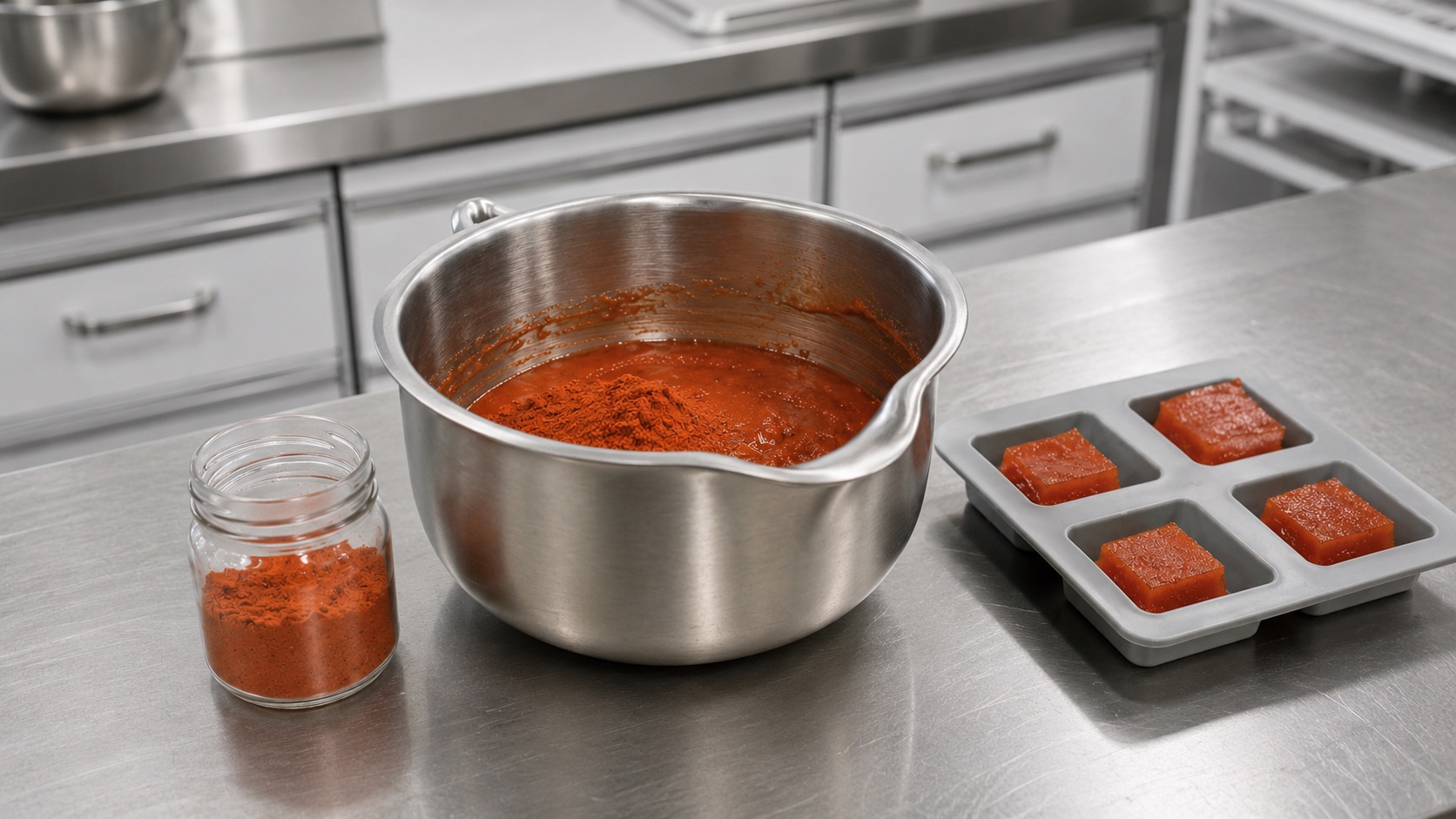
Goji Powder should be reviewed as a formulation ingredient, not as a finished consumer product. The first review is usually physical, but it should still follow agreed criteria.
Appearance and Color
Compare the powder under consistent lighting and against an agreed reference where possible. Natural variation can occur, but the buyer should decide which differences are acceptable for the final formulation.
A visually brighter sample is not automatically the better ingredient. Color may be affected by raw material, processing, moisture, storage and sourcing option.
Particle Size and Texture
Particle size affects handling, mixing, mouthfeel and visual consistency. Buyers should confirm the stated mesh or particle-size range and compare it with the intended processing method.
A supplier description such as “fine powder” is not enough for a technical approval. The sample, specification and future commercial batch should follow the same particle-size logic.
Moisture, Flowability and Clumping
Moisture can affect flowability, clumping, storage and packing performance. Review whether the powder moves freely, forms hard lumps or changes after opening.
The physical observation should be compared with the moisture target and the result shown on the batch COA. A dry-looking sample does not replace a measured result.
Odor and Taste
Odor and taste should be assessed in the context of the intended application. A characteristic goji note may be acceptable in one formulation and disruptive in another.
Record the sample reference and evaluation conditions. Informal descriptions such as “good taste” or “natural flavor” are difficult to use when comparing later batches.
Test It in the Intended Formulation
Bench-top testing should reproduce the buyer’s intended use as closely as practical.
A powder that looks acceptable in the pouch may behave differently in water, a dry blend, bakery dough or another formulation.
Dispersibility
Review how the powder wets, disperses and settles in the intended system. Do not assume that a powder is fully soluble unless the supplier specification and test method support that claim.
Where solubility is not the correct technical description, formulation teams should document dispersibility, sediment and mixing requirements instead.
Color Contribution
Record the amount used, liquid or formulation base, mixing time and observation period. This makes the test repeatable when another sample or commercial batch is reviewed.
Taste and Process Fit
Evaluate taste, aroma and processing behavior at the intended usage level. The supplier should not determine the buyer’s final dosage or product claim.
Compatibility, taste, color and processing performance remain the responsibility of the buyer’s formulation and QA teams.
Match the Sample to the Document Set
Documents to compare before approving a Goji Powder sample
Document or ReferenceSample Label
Document or ReferenceSpecification Sheet
Document or ReferencePesticide, Heavy-Metal and Microbiology Reports
Document or ReferencePacking and Storage Details
Separate Sample Approval from Commercial Approval
Sample approval should lead to a commercial-batch review plan, not an automatic assumption that the next shipment is approved.
Before placing an order, the buyer should confirm:
- whether the commercial batch will follow the same specification;
- whether a new batch COA will be provided;
- which physical differences are acceptable;
- which pesticide, heavy-metal and microbiology reports are required;
- whether a change in sourcing option requires a new review;
- how the commercial sample or pre-shipment reference will be handled.
This distinction matters because the approved sample and the commercial batch may come from different production dates, raw-material lots or storage conditions.
A reliable process does not try to eliminate all natural variation. It defines which variation is acceptable and which differences require a new review.
Related Resources
Share the application, market and documents your team needs to review.
Discuss Your Goji Powder Requirements
Functional Ingredient Supply Partner for B2B Formulation and Procurement Teams.
© 2026 BerryOrigin®. All Rights Reserved.